Hy-Brasil

Ireland, for most of its early history, was seen as being at the end of the world— the very edge. It was where one might encounter demons, dragons and other fearful beasts, or perhaps spirits of the dead. Ireland is just short of where numerous cultures placed their realm of the dead, such as Avalon (Insula Avallonis) and Hy-Brasil, to which Arthur was ferried after being mortally wounded. Still, there were many more formidable and less reputable shades that called Hibernia their home. Even the professional, no-nonsense Roman legionnaires subscribed to these superstitions, and many soldiers had no appetite for the British Isles, with or without the Celts and Picts—at least in the first century. There was too much mystery and supernatural hoodoo to suit these sons of Romulus. One minute, something seemed real, and the next minute it was gone. So it was with the island known as Hy-Brasil in the ocean just west of Ireland: now you saw it, now you didn’t. Even the name is shrouded in mystery. In fact:

A variety of names were used over the centuries for the strange wandering island—Bracile, Insula de Brasil, Brasil, Do Brasil, Brasil Rock, O’Brasil, and even Tír na nÓg on occasion.

A land that appeared and disappeared resonated in the hearts of the early Irishmen, and legends of Hy-Brasil no doubt rekindled these founding myths. Recalling how the Irish valued iron, English author Arthur Young (1741–1820) notes:

Again, iron is considered to act as a charm against malign influence. Can it be that the conquered race held in awe the metal by means of which they were overcome? The Irish peasantry generally considered iron a sacred metal but could not assign any reason for this; thieves were even averse to stealing it. On the other hand, Arthur Young, in his Tour in Ireland in 1776, states that the larceny of iron shoes from the hoofs of horses turned out to graze was a common occurrence.

Of all the metals, the Irish name for iron most closely resembles that of their own country, Erin; the similarity probably gave rise to a story that recounts how long ago the Emerald Isle was covered by the ocean, except when it emerged for a brief period once every seven years. Many had attempted to land on it but failed; at last, one adventurer, seeing the shore recede as he rowed towards it, was so enraged that he hurled his iron sword towards the land, on which it alighted. This broke the spell, and the island has since remained above water; for iron or fire appears to be able to make phantom lands assume solid proportions.

Ancient map, England and Ireland
Hy-Brasil (circled) in this portion of a map of Europe 1570 Abraham Ortelius (1527–1598) credited to Alamy.

I’ve covered this in detail in a post When Eirnn First Rose.

On a mist-laden morning, while navigating the treacherous waters, my crew and I caught sight of high cliffs pierced through the fog. We marveled at the lush greenery atop, illuminated by a golden light impervious to the surrounding gloom. 'Tis a mirage!’ I thought, yet the island beckoned with an undeniable allure. We attempted to steer closer, yet as quickly as it appeared, it dissipated into the ether, leaving us awash with both wonder and longing. More on Hy-Brasil

But back to Hy-Brasil.

Irish historian Roderick O’Flaherty (1629–c. 1718) claimed that during his lifetime, the island was “often visible.” He referred to it as an “enchanted island” and paused to wonder whether Hy-Brasil was “real and firm land, kept hidden by special ordinance of God, as the terrestrial paradise, or else some illusion of airy clouds appearing on the surface of the sea, or the craft of evil spirits.”

O’Flaherty noted that Hy-Brasil was most often seen from Inis Mór, the largest of the Aran Islands, either because of its

proximity to Hy-Brasil or for some other variable, such as the weather. Some speculate that “the geography of Inis Mór, with its elevated cliffs and expansive views of the Atlantic Ocean, would make it a plausible location for those seeking to spot this legendary island.”

The Aran Islands consist of three other islands (Inis Meain, Inis Meas, and Inis Oírr) located at the mouth of Galway Bay on the west coast of Ireland. Furthermore, O’Flaherty mentions someone named Morogh O’Ley, who was said to have spent two days on Hy-Brasil. O’Flaherty repeats the legend that the island can only be seen every seven years.

Inis Mór is about 7.5 miles from the western Irish coast. The ocean depth immediately surrounding the islands ranges from ten to sixty feet. However, as one moves westerly, the depth quickly drops off to 656 feet or more (and can be much deeper).

The most likely place from which to see Hy-Brasil. Ireland, Aran Islands, Inis Mor, Kilmurvey: the 60-metre cliffs on which stand Dun Aonghasa prehistoric fort, believed to be about 2000 years old. Photo credit: Peter Michael Rhodes (Alamy).

An elevated area of the seabed called the Porcupine Bank may actually be the historical and geological basis for the Hy-Brasil island.  However, it is 120 miles west of Ireland and is in 600 feet of ocean water.  So even it existed in shallow water, it would be too far from the Irish coast to be observed.

Hy-Brasil appeared on several different maps of the Middle Ages.

Hy Brasil was represented on charts between 1325 and 1865 (though seldom in the same place twice). Commonly the island was portrayed as roughly circular with a river or divide running through the middle of it. The earliest surviving navigational reference to "Bracile” appears on a 1325 map by Angelino Dulcert who described the island as a strikingly round form.

In the mid-fifteenth century Spain and Portugal sent several expeditions in search of the island. None were successful in locating it.

In the late fifteenth century Britain sent a maritime explorer (John Lloyd) to search for the island in hopes of sevuring fishing rights.  He returned home unsuccessful in his mission.  Meanwhile, eyewittness reports and map entries with caveats continued to appear until the late nineteenth century.

Can there be some truth here?

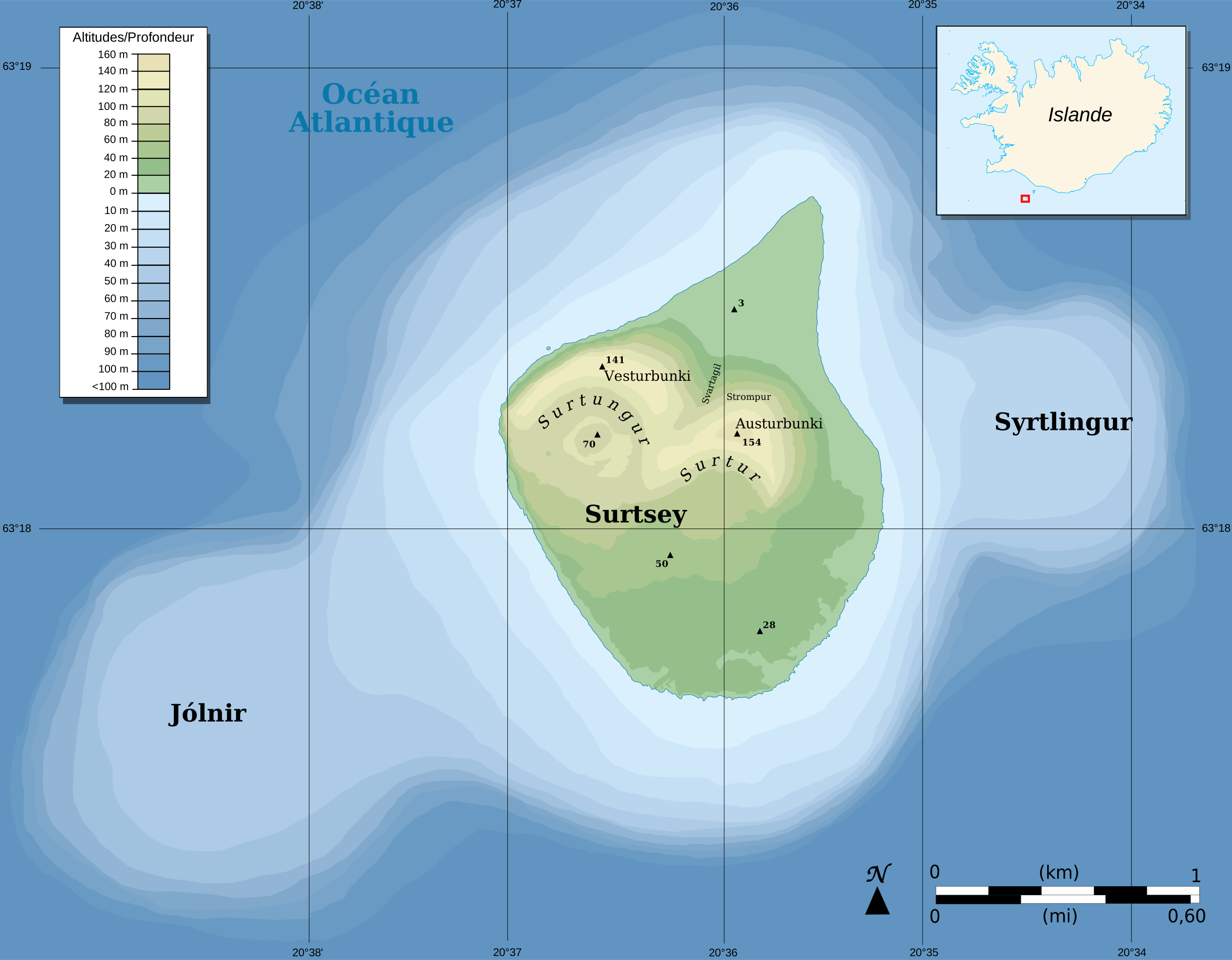
Islands can still pop up suddenly. One example, barely a thousand miles away from where Hy-Brasil was reported to be, is Surtsey, located at 63.303°N, 20.605°W. It began as a volcanic eruption hundreds of feet below the surface of the North Atlantic Ocean and broke the surface on November 14, 1963. The eruption lasted another three and a half years before ending, and the island’s highest point rose to 509 feet. The island reached a maximum area of one square mile, but today it is half that size.

The island was named for Surtr, a giant from Norse mythology. It features moss and lichen across most of its surface, with birds and insects, as well as up to twenty types of plants. However, the sand that covers the basalt as well as the basalt, itself, is continually being eroded by wind and waves, which forecast doom for the island; it is expected to be no longer visible by the end of this century.

Surtsey Island. One of the most recent islands to emerge from the ocean.
Surtsey Island is known for being one of the youngest landmasses on Earth, formed by a volcanic eruption that began in 1963 off the coast of Iceland. Photo credit: Vicky Lewis (Alamy).
Surtsey Island. One of the most recent islands to emerge from the ocean (map)
Topigraphical map of Surtsey Island. Pinpin, CC BY-SA 3.0 , via Wikimedia Commons.

In the Bahamas, there are cays that appear, change shape, and disappear regularly based on tides and storms. At the poles, rocks and small islands are occasionally exposed as the shelf ice retreats. A small island (Zalzala Koh) off the coast of Pakistan was thrust up by an earthquake in 2013 but disappeared beneath the waves three years later.

Still, land that mysteriously appears cannot help but capture the attention and imagination of many who wonder what might be found on that island: Gold? Diamonds? Fossilized remains? Some hint of an unknown civilization? Hy-Brasil certainly fits that criterion.

However, the yearning to discover new secrets and new worlds must now be directed to our oceans and the greater expanse that lies above us.

Verified by MonsterInsights